What Is It?
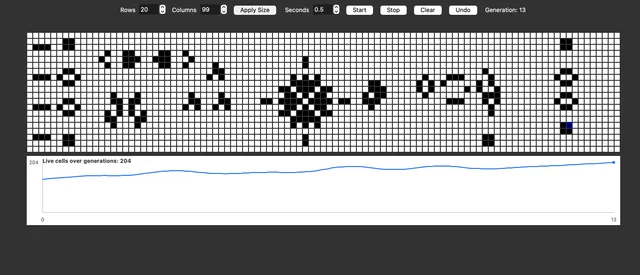
Conway's Game of Life is a cellular automaton created by the mathematician John Conway. It is not a game with players. Instead, it is a world of cells where simple rules create surprisingly complicated patterns.
Each cell is either alive or dead. Every generation, the whole grid updates at once by counting the eight neighbouring cells around each square.
The Rules
A live cell with fewer than two live neighbours dies.
A live cell with two or three live neighbours stays alive.
A live cell with more than three live neighbours dies.
A dead cell with exactly three live neighbours becomes alive.
Why It Is Interesting
The rules are tiny, but the results can look almost alive. Patterns can move, blink, disappear, explode, or create other patterns. That is why the Game of Life is loved in both maths and computer science: it shows how complex behaviour can grow out of very simple logic.
Try the tool above by choosing a pattern, pressing play, stepping one generation at a time, or clicking cells directly on the grid.
A more sophisticated tool
I designed a more sophisticated Tkinter graphics tool with more features like saving, duration, patterns, etc. It runs as a local desktop app, with downloads for macOS, Windows, and Linux, plus an offline ChromeOS Desktop edition. You can also download the Python Source if you want or copy the code.
 Linux AppImage / DEB
Python Source Script
ChromeOS Desktop .apk
Linux AppImage / DEB
Python Source Script
ChromeOS Desktop .apk
Tkinter apps run on your computer, not inside the browser. Contact me if you want a version of the app in a different format, such as x86, Windows 10 ARM (the current Windows version works only on Windows 10/11 x64 and Windows 11 ARM64), or tablets and phones. Tablet and phone versions are not recommended because of their small screens and lack of developer tools.
Third-party notices
Python is licensed under the Python Software Foundation License. Copyright (c) Python Software Foundation and contributors. See LICENSE or THIRD_PARTY_NOTICES for details.